SAE J1850 PWM (Pulse Width Modulation)
- Bus positive pin (2) and bus negative pin (10) of the protocol.
- Uses pulse width modulation at 41.6 kb/s.
- Common in Ford vehicles.
- Pulse Width Modulation changes the analog signal to digital in a square wave.

 Olga Weis
Last updated Oct 1, 2026
When you're trying to diagnose a fault in the OBD port, or create a custom solution to make standard OBD2 requests, you need to know the pinout. Personally, after learning that ECUs in my country are all programmed to respond to standard PIDs (Parameter IDs), I was excited to try it out myself with my Civic. Of course, I wouldn't recommend doing this unless you're completely qualified, and following every guideline! But it worked out. Although, I was confused - why did it use so few pins? This took me down a rabbit hole of manufacturers and pinouts... But first, some information.
On-Board Diagnostics II, or OBD2, is a self-diagnostics and reporting system in modern vehicles. It consists of an Electronic Control Unit, several sensors, and indicator lights. The sensors inspect the various subsystems within the vehicle and report any faults and abnormalities to the ECU.
Of course, simply reporting faults would be pointless if there was no way to read the errors and act on them. Hence, the ECU generates Diagnostic Trouble Codes and stores them for inspection by external OBD scanners. These codes are accessed through an OBD2 connector plugged into the 16-pin OBD port.
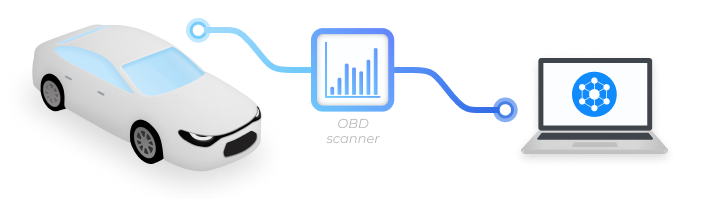
Repair technicians can analyze the error codes using a scan tool attached to the other end of the connector. Whenever I wasn’t confident about the results of a scan, I connected my OBD scanner to a laptop via USB, and sent the results to an experienced technician over FlexiHub!
Read on to learn more about OBD2 pins and layouts used by various manufacturers.

The OBD2 connector is located on the end of the adapter cable that you plug into your vehicle’s OBD port. It is a communication interface that sends information between a diagnostic scan tool and the vehicle’s OBD2 system.
A diagnostic tool can also be remotely shared and accessed with FlexiHub, meaning that a technician can inspect your vehicle remotely, without needing to be present. For more information, check out this article on remote vehicle diagnostics!
OBD2 connectors can be wired and wireless. Wireless OBD2 connectors interface with the scan tool using Bluetooth or WiFi.
The OBD2 connector is designed to read and translate real-time diagnostic information from the Electronic Control Unit (ECU). As such, you can tell what is wrong with the vehicles from the error codes received through the connector. Furthermore, it allows you to use scan tools to reprogram and repair the various subsystems within the vehicle. Recently, remote diagnostic systems have become increasingly popular.
There are two main types of OBD2 connectors:
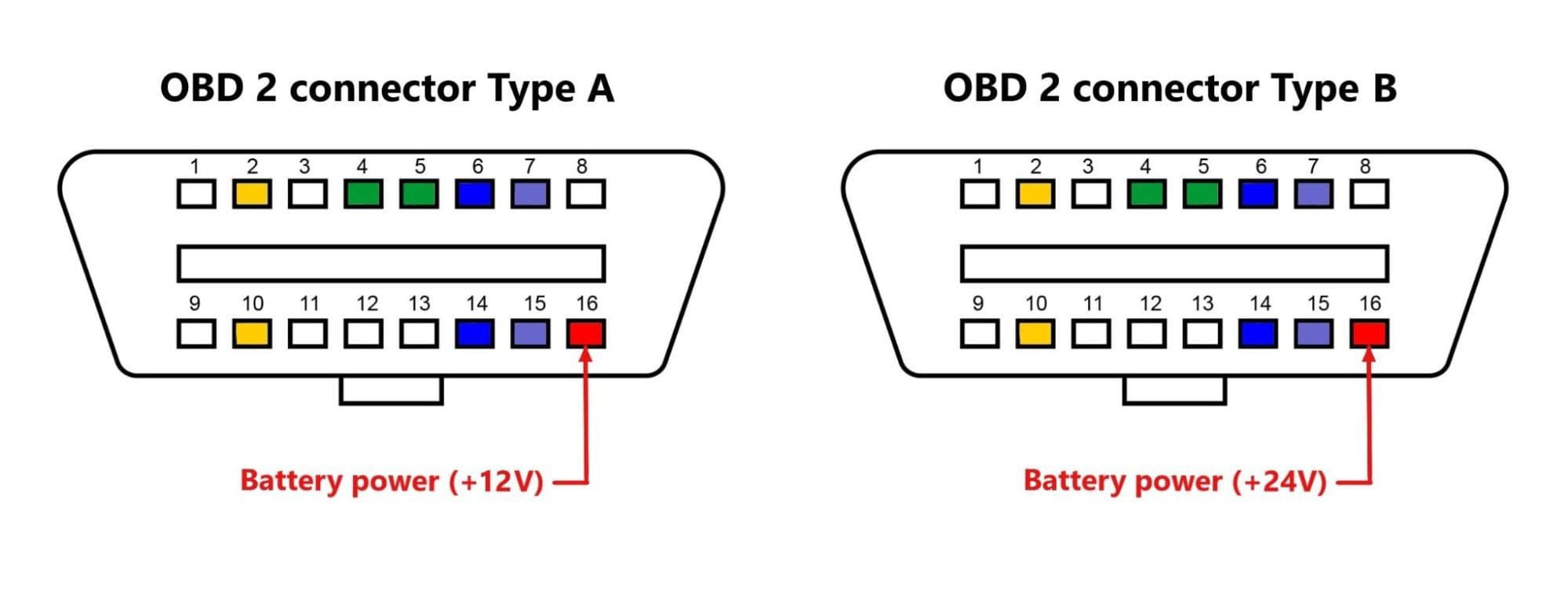
OBD2 connectors are typically 16-pin ports, with each pin serving a distinct purpose. Some pins use standard protocols defined by the Society of Automotive Engineers and the International Organization for Standardization. Other pins are left to the manufacturer’s discretion.
The table below gives a quick overview of each pin in a generic OBD2 connector.
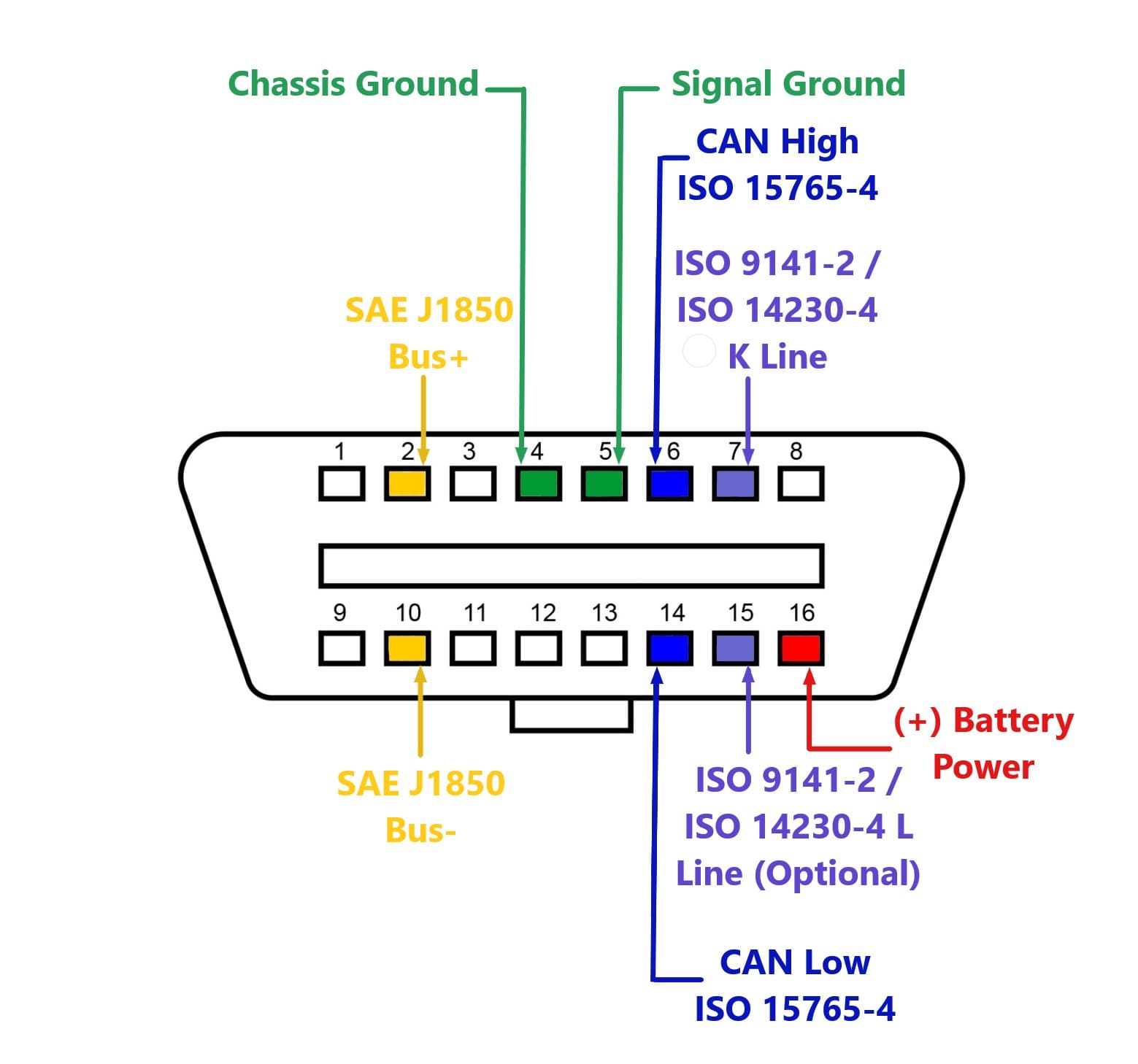
| Pin No | Pin Name | Description |
| 1 | Manufacturer Discretionary | This pin is non-standard and its purpose is up to the vehicle’s manufacturer. It's not required for normal communication. |
| 2 | SAE J1850 Bus+ | Bus positive pin of the protocol. May be used for VPW or PWM. |
| 3 | Manufacturer Discretionary | This pin is non-standard and its purpose is up to the vehicle’s manufacturer. It's not required for normal communication. |
| 4 | Chassis Ground | A grounding pin connected to the chassis. |
| 5 | Signal Ground | Grounding for non-intensive communication signals. |
| 6 | CAN High ISO 15765-4, SAE J2284 | CAN High Pin. Uses a 2-wire CAN protocol at 500Kbps. |
| 7 | ISO 9141-2 / ISO 14230-4 K Line | K line pin. Uses an asynchronous serial communication protocol. |
| 8 | Manufacturer Discretionary | This pin is non-standard and its purpose is up to the vehicle’s manufacturer. It's not required for normal communication. |
| 9 | Manufacturer Discretionary | This pin is non-standard and its purpose is up to the vehicle’s manufacturer. It's not required for normal communication. |
| 10 | SAE J1850 Bus- | Bus negative pin of the protocol. Uses the Pulse Width Modulation protocol. |
| 11 | Manufacturer Discretionary | This pin is non-standard and its purpose is up to the vehicle’s manufacturer. It's not required for normal communication. |
| 12 | Manufacturer Discretionary | This pin is non-standard and its purpose is up to the vehicle’s manufacturer. It's not required for normal communication. |
| 13 | Manufacturer Discretionary | This pin is non-standard and its purpose is up to the vehicle’s manufacturer. It's not required for normal communication. |
| 14 | CAN Low ISO 15765-4, SAE J2284 | CAN Low Pin. Uses a 2-wire CAN protocol at 500Kbps. |
| 15 | ISO 9141-2 / ISO 14230-4 L Line (Optional) | L-line pin. Uses an asynchronous serial communication protocol. |
Each of these pins is explained in-depth below.
Vendor Option pins (listed here as Manufacturer Discretionary) have varying uses. These include additional CAN buses for media transmission or diagnostics. In addition, some pins can be used for purposes that are as simple as engine status indication. In fact, the uses and layouts of these pins may even vary between car models.
Vendors usually don't provide information on Vendor Option pins publically, and, in fact, reverse-engineering these pins can even go against the terms of use of the vehicle. Additionally, OBD2 is often used to update the car's firmware, so messing with unknown pins is especially dangerous. I strongly recommend against experimentation with these pins.
Manufacturers may choose to adhere to different OBD2 standards, or use different pins to implement the same standard. To see the pinout information for standard pins, click any given manufacturer's name in the table below.
| AUDI | BMW | Chrysler | Ford |
| GM | Honda & Acura | Hyundai & KIA | Mazda |
| Mercedes-Benz | Mitsubishi | Nissan & Infiniti | Renault |
| Subaru | Toyota & Lexus | Volkswagen | Volvo |
Some car manufacturers have differently named subdivisions, usually for luxury cars. This is the case for Acura, Infiniti, and Lexus. Cars made by these subdivisions share their OBD2 pinout with that of the parent company, so you can find data on both in the same section. The same applies to Hyundai and KIA - while the latter is not a luxury brand, it's a subsidiary of Hyundai.

| Pin Number | Description |
| 1 | IGN; Switched to +12V when the ignition is on |
| 2 | Unused |
| 3 | Manufacturer Discretionary |
| 4 | Chassis Ground |
| 5 | Signal Ground |
| 6 | CAN High (ISO 15765-4 and SAE J2284) |
| 7 | ISO 9141-2 / ISO 14230-4 K Line |
| 8 | Manufacturer Discretionary |
| 9 | Manufacturer Discretionary |
| 10 | Unused |
| 11 | Manufacturer Discretionary |
| 12 | Manufacturer Discretionary |
| 13 | Manufacturer Discretionary |
| 14 | CAN Low (ISO 15765-4 and SAE J2284) |
| 15 | ISO 9141-2 / ISO 14230-4 L Line (Optional) |
| 16 | Vehicle Battery Power: Type "A" 12V/4A, Type "B" 24V/2A |
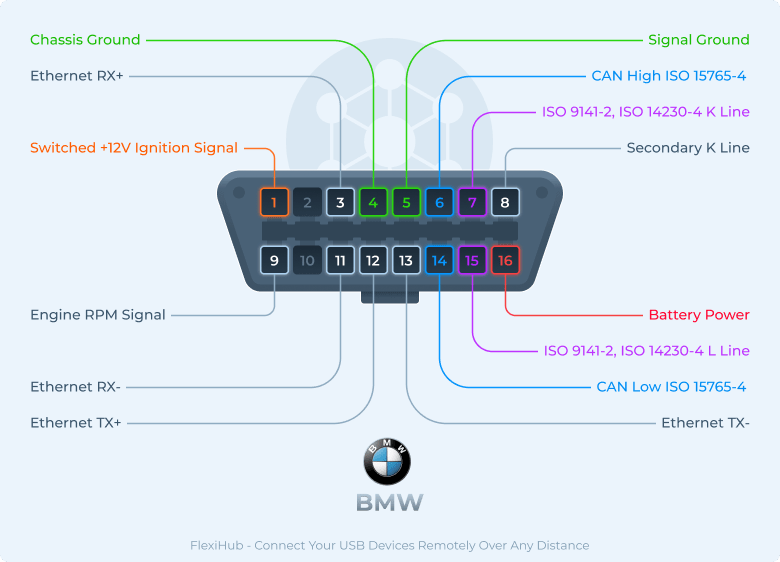
| Pin Number | Description |
| 1 | Switched +12V Ignition Signal |
| 2 | Unused |
| 3 | Ethernet RX+ |
| 4 | Chassis Ground |
| 5 | Signal Ground |
| 6 | CAN High (ISO 15765-4 and SAE J2284) (500Kbps) |
| 7 | ISO 9141-2 / ISO 14230-4 K Line (10.4Kbps) |
| 8 | Secondary K Line for Body/Chassis/Infotainment Modules Ethernet Enable (via 510 Ohm, 0.6 Watt resistor to battery voltage) |
| 9 | TD (Tachometer Display) Signal / Engine RPM Signal |
| 10 | Unused |
| 11 | Ethernet RX- |
| 12 | Ethernet TX+ |
| 13 | Ethernet TX- |
| 14 | CAN Low (ISO 15765-4 and SAE J2284) (500Kbps) |
| 15 | ISO 9141-2 / ISO 14230-4 L Line (10.4Kbps) (Optional) |
| 16 | Vehicle Battery Power: Type "A" 12V/4A, Type "B" 24V/2A |

| Pin Number | Description |
| 1 | Unused (or unknown) |
| 2 | SAE J1850 VPW Bus + (10.4Kbps) |
| 3 | CCD Bus + |
| 4 | Chassis Ground |
| 5 | Signal Ground |
| 6 | • CAN High (ISO 15765-4 and SAE J2284) (500Kbps) • SCI A Engine (RX) (SAE J2610) (7812.5bps, 62.5Kbps, 125.0Kbps) |
| 7 | • ISO 9141-2 / ISO 14230-4 K Line (10.4Kbps) • SCI A Engine (TX) (SAE J2610) (7812.5bps, 62.5Kbps, 125.0Kbps) • SCI A Trans (TX) (SAE J2610) (7812.5bps, 62.5Kbps, 125.0Kbps) • SCI B Engine (TX) (SAE J2610) (7812.5bps, 62.5Kbps, 125.0Kbps) |
| 8 | Unused (or unknown) |
| 9 | SCI B Trans (RX) (SAE J2610) (7812.5bps, 62.5Kbps, 125.0Kbps) |
| 10 | Unused (or unknown) |
| 11 | CCD Bus - |
| 12 | SCI B Engine (RX) (SAE J2610) (7812.5bps, 62.5Kbps, 125.0Kbps) |
| 13 | Unused (or unknown) |
| 14 | • CAN Low (ISO 15765-4 and SAE J2284) (500Kbps) • SCI A Trans (RX) (SAE J2610) (7812.5bps, 62.5Kbps, 125.0Kbps) |
| 15 | • ISO 9141-2 / ISO 14230-4 L Line (10.4Kbps) (Optional) • SCI B Trans (TX) (SAE J2610) (7812.5bps, 62.5Kbps, 125.0Kbps) |
| 16 | Vehicle Battery Power: Type "A" 12V/4A, Type "B" 24V/2A |

| Pin Number | Description |
| 1 | • Infotainment CAN High • Ignition Control (activates low current switching device to power ignition current) |
| 2 | SAE J1850 PWM (Ford SCP) Bus + (41.6Kbps) |
| 3 | • DCL + • Medium-Speed CAN High (125Kbps, 250Kbps) • UBP Network #1 (9600bps) |
| 4 | Chassis Ground |
| 5 | Signal Ground |
| 6 | CAN High (ISO 15765-4 and SAE J2284) (500Kbps) |
| 7 | ISO 9141-2 / ISO 14230-4 K Line (10.4Kbps) |
| 8 | • Infotainment CAN Low • Trigger Signal (multiple module trigger input controlled through the communication link to initiate / terminate an event) |
| 9 | Battery Power (Switched) (vehicle battery power available via the ignition switch or ignition control [Pin 1]) |
| 10 | SAE J1850 PWM (Ford SCP) Bus - (41.6Kbps) |
| 11 | • DCL - • Medium-Speed CAN Low (125Kbps, 250Kbps) • UBP Network #2 (9600bps) |
| 12 | Flash EEPROM |
| 13 | • FEPS — ECU Programming Voltage • Flash EEPROM |
| 14 | CAN Low (ISO 15765-4 and SAE J2284) (500Kbps) |
| 15 | Unused by Ford |
| 16 | Vehicle Battery Power: Type "A" 12V/4A, Type "B" 24V/2A |
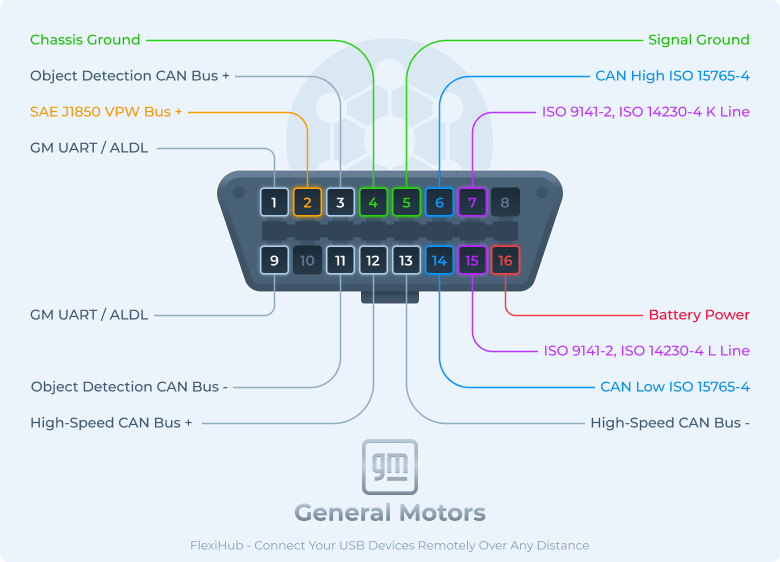
| Pin Number | Description |
| 1 | • Single-Wire CAN (SAE J2411 / GMW3089) (33.3Kbps) • GM UART / ALDL (SAE J2740) (8192 bit/s) |
| 2 | SAE J1850 VPW Bus + (10.4Kbps) |
| 3 | Object Detection CAN Bus + |
| 4 | Chassis Ground |
| 5 | Signal Ground |
| 6 | CAN High (ISO 15765-4 and SAE J2284) (500Kbps) |
| 7 | ISO 9141-2 / ISO 14230-4 K Line (10.4Kbps) |
| 8 | Manufacturer Discretionary |
| 9 | GM UART / ALDL (SAE J2740) (8192 bit/s) |
| 10 | Unused (or unknown) |
| 11 | Object Detection CAN Bus - |
| 12 | Chassis High-Speed CAN Bus + (500Kbps) |
| 13 | Chassis High-Speed CAN Bus - (500Kbps) |
| 14 | CAN Low (ISO 15765-4 and SAE J2284) (500Kbps) |
| 15 | ISO 9141-2 / ISO 14230-4 L Line (10.4Kbps) (Optional) |
| 16 | Vehicle Battery Power: Type "A" 12V/4A, Type "B" 24V/2A |

| Pin Number | Description |
| 1 | Manufacturer Discretionary |
| 2 | Unused |
| 3 | Manufacturer Discretionary |
| 4 | Chassis Ground |
| 5 | Signal Ground |
| 6 | CAN High (ISO 15765-4 and SAE J2284) |
| 7 | ISO 9141-2 / ISO 14230-4 K Line |
| 8 | Manufacturer Discretionary |
| 9 | SCS (Service Check System) - diagnostic codes |
| 10 | Unused |
| 11 | Manufacturer Discretionary |
| 12 | Programming out |
| 13 | Input/Output for VTM-4 and immobilizer control |
| 14 | CAN Low (ISO 15765-4 and SAE J2284) |
| 15 | ISO 9141-2 / ISO 14230-4 L Line (Optional) |
| 16 | Vehicle Battery Power: Type "A" 12V/4A, Type "B" 24V/2A |

| Pin Number | Description |
| 1 | Gearbox diagnostic |
| 2 | ABS diagnostic, BUS+ Line |
| 3 | Manufacturer Discretionary |
| 4 | Chassis Ground |
| 5 | Signal Ground |
| 6 | CAN High (ISO 15765-4 and SAE J2284), ABS/ASR diagnostic |
| 7 | Engine and gearbox diagnostic ISO 9141-2 / ISO 14230-4 K Line |
| 8 | ABS diagnostic |
| 9 | Cruise-control diagnostic |
| 10 | SAE J1850 Bus - (PWM-only) |
| 11 | Manufacturer Discretionary |
| 12 | Airbag diagnostic |
| 13 | Manufacturer Discretionary |
| 14 | CAN Low (ISO 15765-4 and SAE J2284) VSS (vehicle speed) |
| 15 | ISO 9141-2 / ISO 14230-4 L Line (Optional) |
| 16 | Vehicle Battery Power: Type "A" 12V/4A, Type "B" 24V/2A |

| Pin Number | Description |
| 1 | Manufacturer Discretionary |
| 2 | Unused |
| 3 | Low speed (125Kb) CAN bus. This bus is used for some IC, RFA and other units. |
| 4 | Chassis Ground |
| 5 | Signal Ground |
| 6 | CAN High (ISO 15765-4 and SAE J2284) |
| 7 | ISO 9141-2 / ISO 14230-4 K Line |
| 8 | Manufacturer Discretionary |
| 9 | Manufacturer Discretionary |
| 10 | Unused |
| 11 | Low speed (125Kb) CAN bus. This bus is used for some IC, RFA and other units. |
| 12 | Manufacturer Discretionary |
| 13 | Manufacturer Discretionary |
| 14 | CAN Low (ISO 15765-4 and SAE J2284) |
| 15 | ISO 9141-2 / ISO 14230-4 L Line (Optional) |
| 16 | Vehicle Battery Power: Type "A" 12V/4A, Type "B" 24V/2A |

| Pin Number | Description |
| 1 | Ignition control (EZS), air-conditioner (KLA), PTS, safety systems (Airbag, SRS, AB) and some other |
| 2 | Unused |
| 3 | TD engine rotation speed |
| 4 | Chassis Ground |
| 5 | Signal Ground |
| 6 | CAN High (ISO 15765-4 and SAE J2284) |
| 7 | ISO 9141-2 / ISO 14230-4 K Line Engine control diagnostic (ME/MSM/CDI) |
| 8 | Manufacturer Discretionary |
| 9 | ABS, ASR, ESP, ETS, BAS diagnostic |
| 10 | Unused |
| 11 | Gearbox and other transmission components (EGS, ETC, FTC) |
| 12 | All activity modules (AAM), Radio (RD), ICS… |
| 13 | AB diagnostic - safety systems |
| 14 | CAN Low (ISO 15765-4 and SAE J2284) |
| 15 | ISO 9141-2 / ISO 14230-4 L Line (Optional) IC, KI, TAU, LWR diagnostic |
| 16 | Vehicle Battery Power: Type "A" 12V/4A, Type "B" 24V/2A |

| Pin Number | Description |
| 1 | Diagnostic control |
| 2 | Unused |
| 3 | SWS communication line |
| 4 | Chassis Ground |
| 5 | Signal Ground |
| 6 | CAN High (ISO 15765-4 and SAE J2284) |
| 7 | ISO 9141-2 / ISO 14230-4 K Line MPI, CVT, SRS airbags and immobilizer |
| 8 | Manufacturer Discretionary |
| 9 | ETACS |
| 10 | Unused |
| 11 | ECU optimisation control |
| 12 | Manufacturer Discretionary |
| 13 | Manufacturer Discretionary |
| 14 | CAN Low (ISO 15765-4 and SAE J2284) |
| 15 | ISO 9141-2 / ISO 14230-4 L Line (Optional) |
| 16 | Vehicle Battery Power: Type "A" 12V/4A, Type "B" 24V/2A |

| Pin Number | Description |
| 1 | CHECK |
| 2 | Unused |
| 3 | Manufacturer Discretionary |
| 4 | Chassis Ground |
| 5 | Signal Ground |
| 6 | CAN High (ISO 15765-4 and SAE J2284) |
| 7 | ISO 9141-2 / ISO 14230-4 K Line |
| 8 | Ignition ON |
| 9 | ABS |
| 10 | Unused |
| 11 | Adjust Switch |
| 12 | SCI TX |
| 13 | SCI RX |
| 14 | CAN Low (ISO 15765-4 and SAE J2284) |
| 15 | ISO 9141-2 / ISO 14230-4 L Line (Optional) |
| 16 | Vehicle Battery Power: Type "A" 12V/4A, Type "B" 24V/2A |

| Pin Number | Description |
| 1 | Manufacturer Discretionary |
| 2 | Unused |
| 3 | Manufacturer Discretionary |
| 4 | Chassis Ground |
| 5 | Signal Ground |
| 6 | CAN High (ISO 15765-4 and SAE J2284) |
| 7 | ISO 9141-2 / ISO 14230-4 K Line |
| 8 | Manufacturer Discretionary |
| 9 | Manufacturer Discretionary |
| 10 | Unused |
| 11 | Manufacturer Discretionary |
| 12 | LS CAN Bus used for low speed CAN bus, also called as multimedia CAN bus |
| 13 | LS CAN Bus used for low speed CAN bus, also called as multimedia CAN bus |
| 14 | CAN Low (ISO 15765-4 and SAE J2284) |
| 15 | ISO 9141-2 / ISO 14230-4 L Line (Optional) |
| 16 | Vehicle Battery Power: Type "A" 12V/4A, Type "B" 24V/2A |

| Pin Number | Description |
| 1 | Ground |
| 2 | Unused |
| 3 | Manufacturer Discretionary |
| 4 | Chassis Ground |
| 5 | Signal Ground |
| 6 | CAN High (ISO 15765-4 and SAE J2284) |
| 7 | ISO 9141-2 / ISO 14230-4 K Line |
| 8 | Manufacturer Discretionary |
| 9 | SSM (Subaru Select Monitor) timing pulse |
| 10 | Unused |
| 11 | SSM (Subaru Select Monitor) timing pulse |
| 12 | SSM to ECM signal |
| 13 | ECM to SSM signal |
| 14 | CAN Low (ISO 15765-4 and SAE J2284) |
| 15 | ISO 9141-2 / ISO 14230-4 L Line (Optional) |
| 16 | Vehicle Battery Power: Type "A" 12V/4A, Type "B" 24V/2A |
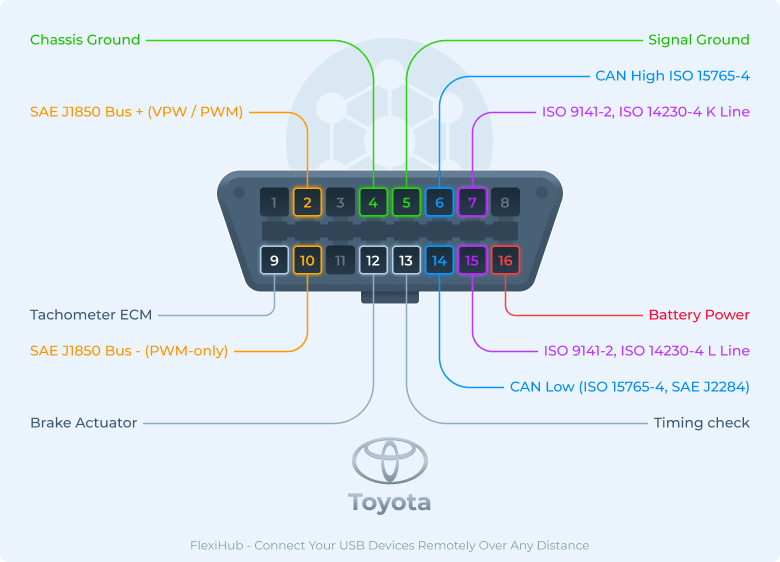
| Pin Number | Description |
| 1 | Manufacturer Discretionary |
| 2 | Unused |
| 3 | Manufacturer Discretionary |
| 4 | Chassis Ground |
| 5 | Signal Ground |
| 6 | CAN High (ISO 15765-4 and SAE J2284) |
| 7 | ISO 9141-2 / ISO 14230-4 K Line |
| 8 | Manufacturer Discretionary |
| 9 | Tachometer ECM |
| 10 | Unused |
| 11 | Manufacturer Discretionary |
| 12 | Brake Actuator Assembly |
| 13 | Timing check - ignition advance angle adjustment or ABS slow codes out |
| 14 | CAN Low (ISO 15765-4 and SAE J2284) |
| 15 | ISO 9141-2 / ISO 14230-4 L Line (Optional) |
| 16 | Vehicle Battery Power: Type "A" 12V/4A, Type "B" 24V/2A |
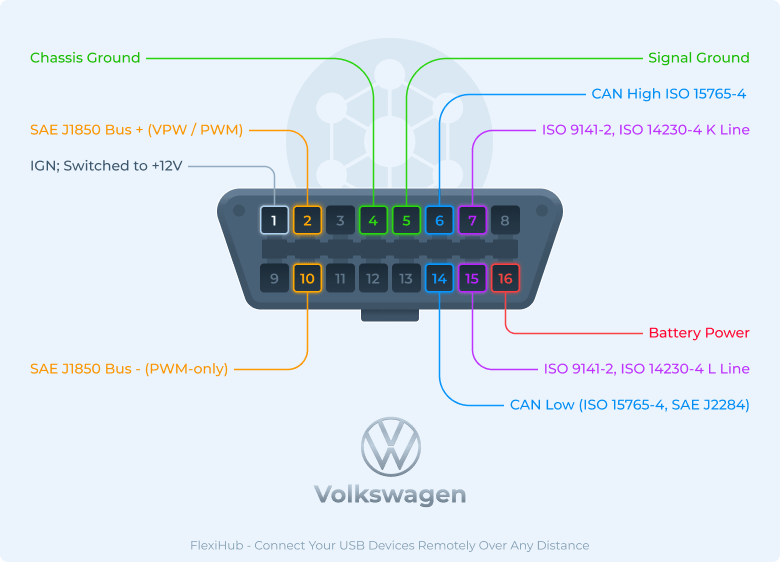
| Pin Number | Description |
| 1 | IGN; Switched to +12V when the ignition is on |
| 2 | Unused |
| 3 | Manufacturer Discretionary |
| 4 | Chassis Ground |
| 5 | Signal Ground |
| 6 | CAN High (ISO 15765-4 and SAE J2284) |
| 7 | ISO 9141-2 / ISO 14230-4 K Line |
| 8 | Manufacturer Discretionary |
| 9 | Manufacturer Discretionary |
| 10 | Unused |
| 11 | Manufacturer Discretionary |
| 12 | Manufacturer Discretionary |
| 13 | Manufacturer Discretionary |
| 14 | CAN Low (ISO 15765-4 and SAE J2284) |
| 15 | ISO 9141-2 / ISO 14230-4 L Line (Optional) |
| 16 | Vehicle Battery Power: Type "A" 12V/4A, Type "B" 24V/2A |

| Pin Number | Description |
| 1 | Manufacturer Discretionary |
| 2 | Unused |
| 3 | Low speed CAN - high |
| 4 | Chassis Ground |
| 5 | Signal Ground |
| 6 | CAN High (ISO 15765-4 and SAE J2284) High speed CAN |
| 7 | ISO 9141-2 / ISO 14230-4 K Line ABS, DSA, TCU AW, IMMOB, ECC |
| 8 | Manufacturer Discretionary |
| 9 | Manufacturer Discretionary |
| 10 | Unused |
| 11 | ECU, Fenix 5.1 (Volvo S40 and some others), Low speed CAN - low |
| 12 | Manufacturer Discretionary |
| 13 | Cruise-control |
| 14 | CAN Low (ISO 15765-4 and SAE J2284) |
| 15 | ISO 9141-2 / ISO 14230-4 L Line Motor |
| 16 | Vehicle Battery Power: Type "A" 12V/4A, Type "B" 24V/2A |
I'm Olga Weis - a car owner (Civic Sedan) and a qualified tech enthusiast. I like pushing mundane devices to their limits. Luckily, many devices have standards they have to follow, and manuals for technicians. Doing repairs myself has saved me from large vendor fees more than once, and doing simple things like customizing my OS is a miracle for my workflow. At Electronic Team, Inc., I work as a technical writer, pouring my heart and my expertise into every article! My credentials can be found at my author page.